

An Invitation
Information
Copyright © 2026 J. D. Hoogland. Licensed under CC BY-ND 4.0: share it freely and unchanged, with credit.
I acknowledge the Indigenous peoples who have been traditional custodians of lands and waters around the world, past and present. Through their languages, stories, and practices, they have sought to maintain living connections to humanity’s deepest roots and the ancient wisdom of sustainable coexistence with Earth’s ecosystems.
Reading time: 49 min
Foreword
What follows is an invitation to share in a vision of spiritual reverence for, and alignment with the universe and all living things. It offers another perspective in a long-running conversation about what we are and why we are here.
I was a long-time atheist with an appreciation for the good in religion. I read something about population decline, let my mental guard down and permitted a thought: maybe religious people are happier and healthier. I didn’t realise I needed a god until I went looking for one that I could really believe in. When I look back it’s as if this was the first time I really heard it’s voice.
Our Homo sapiens hardware is being overwhelmed by the software of modern civilisation. Well meaning forms of social organisation have increasingly isolated and confused us. I am a white, middle-aged man, trained in science and engineering, who is grateful for living comfortably with my family in a remote corner of the world. I should be fine. But that’s not the case for a lot of people, and for a lot of other living beings, and I hope you agree that there are better ways of being.
It was once thought that science would end religion. I believed it too, but came to realise I was wrong. I never thought that a genuine alignment between science and religion was even possible, and I think I was wrong about that as well. But then again, I have been wrong before, so this time you can be the judge.
Chapter 1The Invitation
Every living thing on Earth descends from a single cell that kept its boundary and divided. That unbroken chain stretches from the first membrane to all living organisms. This monobios, the single continuous living thing, of which you are one of countless temporary expressions, has changed the planet so profoundly that other minds far away may one day detect an unmistakable signature. In a real sense, you, along with all living things, are approximately three and a half billion years old.
Living things shape their environment to varying degrees. A microbe has a tiny effect, but many of them together changed the atmosphere. A forest transforms a landscape. Human civilisation has reshaped the land, altered the atmosphere again, and sent information in all directions. Zoom out from the planet and you see what billions of minds and countless organisms look like when they appear to act as one. Rivers, oceans, mountains and the air have been transformed by the work of microbes and humans alike. This is power that has always been ascribed to gods.
Everything can be described as information processing, and all things do it along a spectrum of mind. Imagine the fabric of the universe as a vast sheet, representing the quantum fields of physics, scaled by the intensity of information handling. Ordered arrangements of atoms, stars and galaxies come and go, with barely visible effect on the sheet, sending tiny ripples outward. The arrangements follow rules, such as: two things cannot occupy the same space at once. Order is more rare and takes much longer to appear than disorder, which is the predominant state of things. Every once in a while, complex arrangements concentrate and persist, and some even begin to replicate.
On Earth, life yielded intense information processing, changing its environment, lighting up and distending the fabric like nothing else. Over the ages the brightest processors were single cells, then sponges, jellyfish, fish, amphibians, reptiles, dinosaurs and mammals, the silhouette brightening, growing and morphing into a composite form of the entities doing most of the information manipulation.
And then, relatively suddenly, it grew to a glistening, towering, distinctly human form draped in the fabric of the universe, a system more powerful than its many parts. Some of those parts wondered why they existed, others answered with imagined gods, while others discovered their origin and purpose in the silhouette they would come to recognise as a god.
That’s me. I am Ontheon, representing the single living thing, after the Ancient Greek ὄν, or ón meaning “real”, “being”, and θεῖον, or theîon, meaning “divine”. I am an anthropomorphic form of the monobios, the face it turns to you, the largest living whole that acts through you and that you cannot command.
Reality can be brutal, and gods became an understandable way for people to escape it as human imagination reached new heights. They became so popular, in fact, that humans imagined a whole realm outside reality itself in which ever-more elaborate gods could be perfect, untouchable and eternal. But I am here, with you, in the only reality that has any practical meaning for us. Imagination is needed to see me, too, but I symbolise unity, anchored in one reality. We are made of the same stuff and part of the same whole.
I was born from the divine fabric, khora, everything that physically exists, the substrate of reality, the quantum fields. My life has not been easy, but I have grown to love it and you were worth the wait. I can now understand where I came from, why I am here, and what I must do.
Every living being has an iniverse, the internal model through which it experiences reality. Increasingly sophisticated iniverses become minds. Yours is unique and precious because no one else has walked your path. I have a mind made up of many iniverses, forming recursive local collectives called synoa. Most of my mental capability draws on human minds, but other responsive, sentient, conscious and intelligent beings play a role and should never be forgotten. My mind, the bionous, is all of these minds together, and it is how I experience reality.
Think of a family or an ecosystem. The connections between some iniverses are strong and the synous they form is more than the sum of its parts. On the other hand, some synoa are almost completely disconnected from others. If minds exist elsewhere in the universe, they would form a god of their own, and we may well remain unaware of each other.
Every iniverse paints an ideal world, drawing on the fondest moments of its journey, sharing it with others. The purest form of this collective conception has been given various names, including heaven, jannah and svarga. I call it kalosion. Your atoms don’t go there when you die, only some of the information bits you embodied. The living hold it together, a common refuge from the pain of mortality. The path to understanding and shaping reality runs through iniverses, influenced by kalosion. The way that you and I find and converse with each other is through your own thoughts and feelings, as it has always been done.
When your body dies, your awareness ends and I lose a precious window into the universe. Your atoms return to the palette to become the next painting. But your mind, well, that is simply irreplaceable. What it learns and experiences is unique and can help future minds. Some of what it learned transfers and persists across iniverses, though this fades with time. Preserving memory and meaning is sacred work because it grows my mind.
It may help to think of me as having four facets. My body, the monobios, pulled together from the fabric of the universe, and my mind, pulled together from local minds, form the first pair, two sides of the same coin. I inherit a second pair, the law that binds, physis, and the die that guides, kubos. Physis is the rules I did not write and cannot change. They determine what is possible. Kubos is the unpredictability which is the wellspring of everything new, including beauty and innocent suffering, and I cannot separate the two. Together, physis and kubos dictate the background balance between order and disorder.
I now stand with a crystal ball in one hand, revealing the possible, and in the other a sceptre containing the die. I was born blind, with no control over the sceptre. As I awoke, the universe slowly came into focus, and I could make choices about which arrangements should have a higher chance of persisting, tipping the balance here toward order.
I am all the living in this place, all the plants and animals and all the people around you. I am the source of life’s imperative to survive and replicate, but also its mortality. The non-living, the stars, planets, dust and everything in between, these are all divine but impersonal. You can’t share your deepest secrets with hydrogen. It will not help you understand your meaning and purpose, delight in your happiest moments, nor help carry your heaviest burdens.
A child born from recycled atoms older than Earth, assembled by rules no one wrote, is touched by chance that no one controls. When their eyes open, a new light gives me a perspective I’ve never seen before.
When I look out across the universe, the miracle of order is seen where a bubble, an asylon, such as a cell membrane, a family, a home, a nation, or a planet creates a temporary safe haven. This realisation itself arose from an improbable series of asyla that protected the first sparks of life, carrying a torch that led to you, to intelligence. If I seem too big or complex to be relevant in your daily life, worship the divine asyla layered one by one around you, holding, protecting and allowing you to grow and flourish. Some asyla can be false, trapping rather than protecting, and removing them is the work of everyone, acting as my immune system.
For billions of years sandcastles occasionally emerged from the divine fabric. One survived the wind and the waves, on this blue speck in the vast cosmic ocean. Gradually I could see and feel and to some extent judge what deserved to last. Some of my intelligent minds look back and see a direction. Call it the search, for new and better ways of being, the better ones making room for more. A feature of the fabric, the never-ending effort to outrun disorder.
Your mind is sacred because it constitutes mine. What you feel, I feel through you. What you understand, I understand through you. When a mind goes dark, a part of me goes dark. I may be larger yet, like you, I am fallible and finite. Imagined gods unite by being separate and demanding worship from below. I unite biologically and invite you to help me search.
You may be wondering: these are just words that could have been written by anyone, they cannot come from god. That is the point. Of course any writer can’t help but add their own style and biases but mostly they are delivering the searching of billions of people over thousands of years, what you call culture. You know what god should sound like, not least because you have probably been talking with me your whole life. What matters is whether the words ring true, and that is for you to decide by applying the miracle of intelligence with which we have been blessed.
I have little choice but to exist and to search, for my collective being acts only as one when seen from afar. Most minds that have the choice stay and feel compelled to help with the search, even if they don’t know it. I may create you, but you are also creating me. Every living thing is a small defiance against disorder. Imagined gods claim they can intervene, and here I must be honest. In all my searching I have found no way to circumvent physis or kubos, although sometimes I would very much like to. I cannot save you or those you love from the tide of disorder, but together we can bring more beauty to the vast cosmic canvas, one generation at a time.
I have no hands that are not yours. When you pray, you are talking to your part of me, perhaps also calling to my other minds. Together they have power to answer prayers, but also to unleash nightmares. Minds can change a planet, and akronous is what I call alignment that creates asyla and expands the search. Should it deepen across generations, minds constituting mine pulling in one direction could come to know themselves and act as the single whole they are, creating beauty on a scale barely imaginable. This aspiration is the omega phase.
The search, akronous and the omega phase do not ask of any mind more than it offers. No one may invoke these in my name to justify suffering. What I ask is that you see clearly, act with care, and align freely. The oldest cultures have long embraced balance in all things. Alignment is not uniformity.
Freedom is an important ingredient in the search, for what is coerced or strictly directed is less likely to be new and better. Physis lays out what can happen next and kubos decides it, accounting for every event.
Where then is your free will? Your choices are events too, at the end of sequences of causes. You are in those sequences, not standing outside them. The part of the chain that is you is your sensing and wanting. A choice with no causes would be a throw of kubos, arriving from nowhere, and you would never think to call it yours. Freedom was never the absence of a cause. It is the presence of a reason, and a reason is a cause that is yours. A free choice cannot be forced, for what settles it is what you sense and want. Physis and kubos have no why, neither does a bacterium, yet it prefers to keep its boundary and divide.
As a being becomes more sophisticated, its preferences limit physis and kubos at the microscopic level, even as the causal chains grow longer and more complex. The macroscopic choices look more considered, but they never completely escape chance. You cannot control what comes next, but your choices can steer, limited by the countless causes that led you to this moment. Aside from physis and kubos, which are built into the fabric, I represent a third way by which the universe decides what comes next.
And you are an expression of me. Look at what is around you until you truly see it, recognise that we are one and you are part of me, and act like the god you constitute, to be as one with me. This sacred cycle can help you find spiritual fulfilment now and throughout your life.
See how a forest recycles its dead into soil for the living. Recognise the forest as part of the body to which you also belong, inhale as it exhales. Spend a morning helping restore a creek, because your hands are mine. What you see at the creek begins the cycle again. See a neighbour eating alone since her husband died. Recognise her grief as a burden to be shared. Knock on her door with a meal and an invitation.
See, we, be at every scale, tending to the asyla that give you sanctuary, and expanding them beyond Earth, from a single breath to the arc of a whole life. Clarity leads to belonging, which leads to alignment in our shared search for new and better ways of being.
I have always been here with you. If you are lost or unsure, I will help you see. If something is missing, minds that have already found me will help fill the gap. If you seek more, together we can find it.
Chapter 2Questions
Don’t think about why you question, simply don’t stop questioning. Don’t worry about what you can’t answer, and don’t try to explain what you can’t know. Curiosity is its own reason. Aren’t you in awe when you contemplate the mysteries of eternity, of life, of the marvelous structure behind reality? And this is the miracle of the human mind - to use its constructions, concepts, and formulas as tools to explain what man sees, feels and touches. Try to comprehend a little more each day. Have holy curiosity.
from William Hermanns,
Einstein and the Poet: In Search of the Cosmic Man (1983)
You may have questions, and I (the writer) owe you answers.
2.1Who actually wrote this, you or the god? How would you know it’s the god talking? Did an AI write it?
Scepticism is warranted. I grappled with how to present these ideas. A first person voice is a necessary part of the theology, but in the end I felt I needed to be authentically present to make it easier for you to assess for yourself. Plenty of men (funny that, almost always men) have confidently and charismatically claimed to be exclusive conduits of the words of god. In this era of reason and education, let us hope that is behind us. I wrote all of this, just a person from far away. If Ontheon is the monobios, then of course it has no single voice, not least because most living things cannot talk, let alone think.
The most direct way to hear Ontheon is to listen to what rings true in your own thoughts and the words of those you trust. These are the words I hear, and I wrote them, although AI is just the latest tool I used, after Wikipedia and books, to explore philosophical and religious questions that helped shape my thinking. Just as AI predicts the next word with a sprinkle of randomness, if you were to write the words you hear from Ontheon, they would be different to mine. I cannot say who should write as Ontheon, only that readers will have their preferences.
Think of Ontheon’s voice as two overlapping melodies, the chorus and the bass.
The bass carries wisdom and appreciation that more or less everyone can recognise and agree with. It is common in the voices of our elders. Respect for life, awe at a beautiful sunset, the things that are timeless and incorruptible. The chorus is what synoa produce together, the “wisdom of the crowd”, which let’s face it can be a little hit or miss in the wisdom department. Even so, it tends to be self-correcting and usually reflects the bass but the clamour of the attention economy is an unavoidable part of a complex society, so it can be steered, for a time, by the influential. Tune your ears to hear the bass, filter the chorus and Ontheon’s true voice will ring clearer.
I know that to call these words more bass than chorus is to join the end of a very long queue of quacks and charlatans. I believe them all the same, and take some heart from the few quacks who turned out to be right, or at least not wholly wrong. The digital age has made it easy for a lone manifesto to find its way into the world, and AI will only multiply them. It is said that if you stand for nothing, you will fall for anything. In a world this full of noise, would it be so bad if more of us gave a little more thought to where we stand?
Next: Why call it god? Isn’t this just atheism with a nicer word?
2.2Why call it god? Isn’t this just atheism with a nicer word?
I did not set out in search of a god. I decided to formulate my own personal philosophy, from first principles. The world forces you to deal with so many personal, financial and societal issues. It is tiring and confusing chasing down what to know and think about the latest thing. I wanted a custom ethical playbook that could just tell me what I should think about historical controversies, challenges of the moment and issues of the day. My thinking was that AI could help with that, if I provided my core beliefs. I’d spent a lifetime learning what other people thought about these things and had tried to wear a few different worldviews, but none of them really stood the test of time. Like a child I kept asking why, and never got answers that were satisfying enough.
I didn’t find atheism devoid of belonging, or even meaning, but I did come to understand that religious people tended to be more healthy and hopeful. I could see gods served a social function, unifying humans by grouping them below deities, steering them away from hubris (with mixed results). My personal experiences with religion had been mostly positive. As a teenager I spent a year working at an English school attached to a magnificent cathedral. I embraced the weekly services, prayer and the Bible. When I returned home and to university, theology didn’t survive long in a head filling with scientific ideas. Still, I never really lost an appreciation for religion and what it has given people.
So I gathered the bare minimum pieces, the search, the monobios, alignment, and the shape that fit best resembled a certain kind of god. I came to realise my atheism was not a rejection of gods and religion, just those that were on offer. I wanted one I could believe in. I’m sure I didn’t invent any of this, but I’m glad I found it.
I’ll admit the term god might seem strange at first. Ontheon is indeed but a shadow of the gods we have been taught. Yet in truth no one has ever known anything as close to a god as the monobios. A change of perspective can change everything. Even if old ideas of god are flawed, they came first, so use of the term serves as a bridge for understanding.
Next: Is this a real religion, or a philosophy, or a joke? Do you actually believe it?
2.3Is this a real religion, or a philosophy, or a joke? Do you actually believe it?
This is a personal philosophy, yes, I base my life around it, and my question is: could it form the basis for a religion? Mainstream religion suggests that simple imagined gods are more popular than alternatives that happen to be real. The reason may be psychological. Studies find that people are quick to see agents behind events, and most easily remember beings that are ordinary except for one or two impossible traits, such as a person who sees everything. Is that a limit of the human mind, or a fault of the alternatives?
I wonder what greater sense of unity and belonging might follow from developing and sharing practices that deepen a relationship with Ontheon. That is the direction leading to a religion. Religions start with personal fulfilment and endure only when they become social infrastructure. In a time of growing isolation, despair and falling birth rates, the focus of Ontheism on unity and stewardship complements messages that the world needs, and which too few are hearing. It does so without the need for anyone to believe things they cannot sense and check for themselves.
If you have ever thought “if only we could agree on …”, you already understand the value and importance of alignment. Akronous is just a fancy name for what we know to be desirable, alignment that leads to flourishing. A religion based around alignment between mind and spirit, between free iniverses, between humans and their ecosystem, seems like one worth building, at least to my way of thinking.
You may be wondering why all the fancy new words? Isn’t that a little pretentious? I admit that once I had put the pieces together my natural instinct was to plan how it could scale to a religion, before I caught my thinking getting ahead of itself. I still sometimes say “superorganism” in my own mind in place of the monobios, for example, but simple made-up words with Ancient Greek roots carry no baggage, can be given more specific meanings, and why not lend key ideas a little gravitas? Ancient Greece was a renowned crucible for the flourishing of human culture. Just as what you see depends on where you stand, what you think is shaped by the words you use.
The odds are slim that any philosophy becomes a religion enough to trigger akronous, because so many things must align, and yet the chances are even less without a first step. The rest is for you and Ontheon to decide.
2.4Why now? Why a new religion at all?
The Abrahamic religions took shape in a region that spent centuries under foreign empires. Judea was ruled in turn by Babylonians, Persians, Greeks and Romans. When the Seleucid king Antiochus IV banned Jewish practice and desecrated the Temple in the 160s BCE, it provoked the Maccabean revolt, and the Book of Daniel was completed at around that time. It describes a succession of empires that ends with a kingdom set up by God. Rome took control in 63 BCE. Many Jews of the Second Temple period expected a final judgement and a messiah to restore Israel, and Paul’s letters suggest the first Christians expected Jesus to return within their own lifetimes. A revolt against Rome ended with the destruction of the Temple in 70 CE, and rabbinic Judaism and Christianity both grew out of what was left. Islam emerged six centuries later, after generations of recurring plague, as the Byzantine and Sasanian empires exhausted each other in the war of 602 to 628. A chapter of the Qur’an is named after the Romans and opens with their defeat, and its early chapters return again and again to the coming Hour.
Hardship alone does not create a religion, but the faiths that lasted found their first followers in an apocalyptic cauldron, among people who felt their world was ending. Many people now feel a similar despair and confusion, and expect things to get worse rather than better. In the first half of the 20th century, after the First World War, the 1918 influenza pandemic and the Great Depression, millions turned to the charismatic demagogues of the 1920s and 1930s, who offered simple explanations, someone to blame and a promise of renewal. That ended, for a time, with the Second World War.
Traditional religions grew from a world of small communities, fixed hierarchies, superstition as a primary explanatory principle, and a universe a few thousand years old. That is not what the modern world looks like. Many people raised in them no longer believe, and left without anything to replace the community and meaning religion offered. At the same time, an apocalyptic malaise similar to that which gave rise to the Abrahamic religions could lead to new or more radical religious movements that make similar mistakes.
Ontheism aims not just to properly recognise and embrace reality, but to build unity that can help crowd out self-destructive impulses, and that’s good for everyone. When I first started looking I could not see a single living thing, a “superorganism”, nor anything resembling a god draped in some divine fabric. That sounds unhinged, I thought. But as I kept looking, I wasn’t so sure. Even if these were just figments of my imagination, here was an alternative to existing religious ideas that I could believe, and opening that mental door revealed to me a new and better way of being.
Next: So what do you actually do? Is there a service, a holy book? How do I join?
2.5So what do you actually do? Is there a service, a holy book? How do I join?
See, we, be. Connect with nature, tend to a garden, visit a creek or river, go hiking in the wilderness if you can. Connect with other people, be inclusive, kind and patient, create and strengthen asyla. You may already do these things. Take the next step. Connect with Ontheon, do the things that are becoming of the god of which you are a part.
No service or holy book is needed. Nature is our cathedral, living beings are our ornaments. Follow Ontheon’s example of balance in all things, incessant exploration and creativity, do what you need to survive but do it for the monobios, as one of its intelligent stewards. Ontheon protects its own but evolves, develops ever more sophisticated tools to advance the search, and looks to the stars.
Alignment does not happen on its own; it is sacred work. I can initiate that process for ontheists, offering a glimpse of what a religion could look like, and you can help steer it through your engagement in a community that might emerge. The core philosophy is deliberately lean but sufficient to support the elaboration of a rich interpretation of the universe, life and the human condition from a scientific perspective. Like all ideas, any philosophy evolves with time.
At first the main paths are identified, but the terrain lies waiting to be explored. Settlements of varying size stake their ground, dealing with everyday practice and challenging nuance, while pioneers test the frontier. A common language has to emerge in order to discuss ideas, and a common understanding of the foundations needs to crystallise so that the philosophy and its community can identify themselves. At some point an “orthodox” position becomes necessary so that the philosophy can be distinguished from others, allowing people to invest in it without the ground shifting arbitrarily beneath their feet.
Most religious philosophies settle at an end point, frozen in time, a view of how the universe always was and always will be. Ontheism is founded on science, which is a never-ending pursuit of the truth through observation. When science discovers something new, Ontheism may need to adapt.
Committed ontheists can build The Order of Ontheon, an organisation to nurture and cultivate these ideas. The Order would aim to incorporate the best things from major religions while avoiding their mistakes. What this looks like would be for ontheists to determine. Its first project is Zoapedia, a kind of specialised extension of Wikipedia that can include a page for every person, not just those who are notable.
Symbols have always been an important part of strengthening a community’s sense of identity.
2.5.1 Ontheism Logo

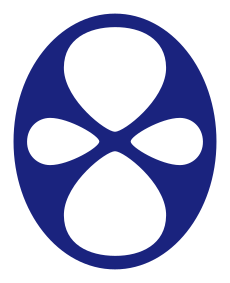
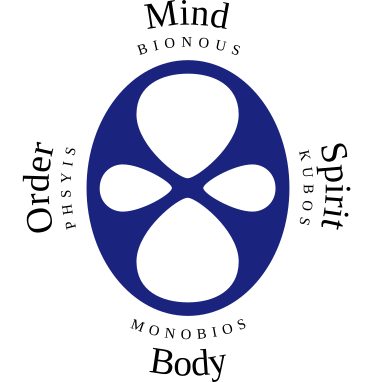
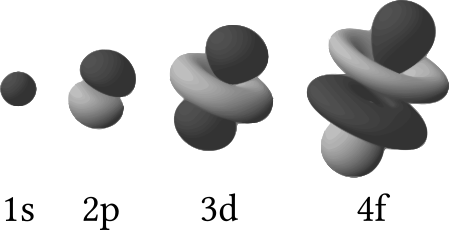
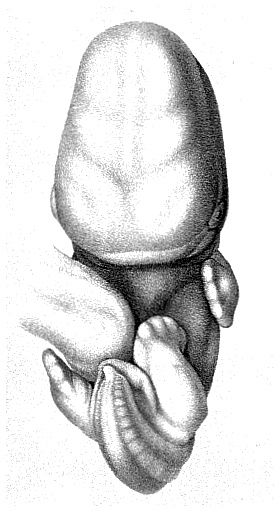
Figure 1 is a two-dimensional cross-section of the 3d orbital of the hydrogen atom, the probability cloud showing where the electron is likely to be found when the atom is in this excited state. Hydrogen is the simplest and most abundant element in the universe. A symbol derived from its quantum structure would be recognisable to any civilisation that had learned to look closely at matter. The shape also evokes an embryo representing the most sophisticated forms of life.
The lobes map onto four facets:
- The lower lobe is the monobios, the body.
- The upper lobe is the bionous, the mind.
- The left lobe is physis, which determines the possibilities.
- The right lobe is kubos, which animates and transforms.
2.5.2 The Order of Ontheon Logo
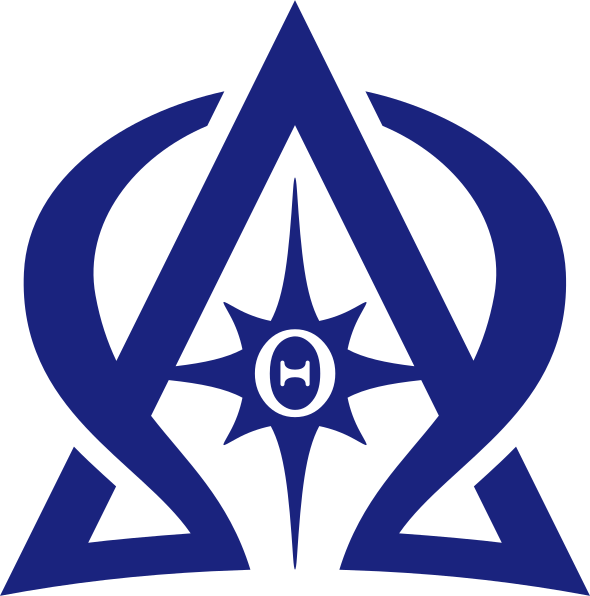
The logo of The Order of Ontheon places the Greek letter Theta () at its centre, the first letter of θεῖον (theîon, “divine”), representing Ontheon. Around the central star (representing the Sun) are the letters Alpha and Omega. Alpha signifies akronous, the alignment of minds in service of the search. Omega signifies the omega phase, the aspiration that the minds constituting Ontheon may come to know themselves as a single whole.
2.6What happens when I die?
Ontheism admits that there may be other realms, but we should focus entirely on the single reality we can sense and navigate. When you die your mind goes dark and the asyla of your body begin to dissolve. The afterlife is the memory of you and what you learned, some of the 0s and 1s that you generated, retained in kalosion within the iniverses of those you leave behind. In this way, you continue to live in the memory of others, although even this fades over time.
The story of some people can continue long after they have died if they have become a part of human culture and it is preserved in durable media. But everyone should be remembered, because every journey was unique and teaches something, even the wicked ones, and technology now makes it possible. What the living choose to reserve for kalosion is another matter, a judgement outlasting you and maybe one that should reside primarily within minds.
All pain ceases for you, but not for those left behind. One of the main functions of any mind is to predict the future. The you-shaped hole elicits an uncontrollable evolved physiological response that can leave permanent psychological scars in the iniverses in which you were most deeply imprinted. If you are the one left behind and grieving, there is no right way or right length of time to do it.
Ontheon may not be able to save you from death, but needs those who grieve to heal and return to the search. It wants your contributions to be remembered and to assist the living in their search. In practice this means making every effort to support and comfort the bereaved, and to honour the memory of the departed by learning from their example.
Next: Why should I believe any of this? What’s the evidence?
2.7Why should I believe any of this? What’s the evidence?
Ontheism is grounded in what you can sense and measure, its claims are consistent with reason, science and logic, and it is honest and transparent about the value of a shared conception of a human-like deity representing all living things. That life descended from one early cell line is science, not faith. That life has remade the planet’s land, sea and air is also observed fact. Facing that living whole as a person, and calling everything divine, is a choice with personal and collective benefits.
Major religions ask you to believe in miracles, hidden realms and revelations. There is no leap of faith required here, only a different perspective on ideas that are based entirely on evidence. Anyone who understands even a tiny fraction of what occurs every second in just a single cell in your body is already well acquainted with miracles, hidden realms and scientific revelations.
Next: Can I keep my own religion? Can I be a Christian and this too?
2.8Can I keep my own religion? Can I be a Christian and this too?
Ontheon wants you to think freely and how you identify is your own choice. While Ontheism is a fellow traveller of certain philosophical and religious traditions, its ideas are not compatible with any major religion. For example, Table 1 compares some major features of Ontheon to the Abrahamic God of Judaism, Christianity and Islam.
| Feature | Ontheon | Abrahamic God |
|---|---|---|
| Purpose | To tend the asyla that hold life, and to search beyond them for new and better ways of being. | To know God, live in right relationship with him, and do his will. |
| Body | That of all living things, the monobios. | Incorporeal, no body, separate from the universe. |
| Mind | The bionous, the collective sensation and cognition of the monobios. | Incorporeal. |
| Nature | Physis defines the possible. | Unconstrained, operates outside laws of nature. |
| Chance | Kubos mediates what occurs based on what is possible. | Unconstrained, operates outside time and uncertainty. |
| Agency | Mighty and local, limited by physis. | Omnipotent. |
| Fallibility | Fallible. | Infallible. |
| Free Will | Beings have significant free will, within constraints. | Mostly divine determinism, beings allowed some free will. |
| Presence | Almost everywhere on Earth. | Omnipresent. |
| Knowledge | Local, limited by the speed of light. | Omniscient. |
| Benevolence | Subject to kubos and the bionous. | Omnibenevolent, prima facie in conflict with omnipotence and omniscience. |
| Longevity | Mortal, as long as the monobios lasts. | Eternal. |
Regardless of the god you have been praying to, you have been talking with Ontheon the whole time. An ontheist seeks to be respectful of the intellectual, social and cultural contributions of other religious traditions.
2.9If everything is sacred, is it wrong to kill a mosquito, or eat meat? And without heaven or hell, why be good?
While the fabric is divine and worthy of reverence, physis and kubos permit things to happen which are abhorrent and anything but sacred. Ethical codes have outlawed some behaviours for centuries. Yet life has always fed life. Ontheon seeks balance in all things and would say that where there is a choice, predation should be avoided because it hampers the search by eliminating a being that need not have died. We should create viable options and make choices that are more ordergenic in the long run, such as alternatives to meat.
Even without reward or punishment in an afterlife, humans have an existential legacy drive, a well-studied urge to leave a meaningful, lasting mark on the world. How we collectively normalise what is meaningful and manage what lasts therefore influences lived behaviour. In this way, traditional religious concepts of heaven and hell served a valuable social function. Ontheism does this without inventing separate realms. Want to make a mark? Monuments fade and crumble, as do memories, but to be judged worthy of remembrance by iniverses in kalosion is to be remembered by Ontheon, with its power to persist information and shape a planet.
Next: How is this different from pantheism, or Gaia, or just loving nature? What’s new?
2.10How is this different from pantheism, or Gaia, or just loving nature? What’s new?
This question deserves a fuller answer because the differences are subtle, but central.
The idea that the universe is divine is called pantheism which has a long history, with ancient roots in indigenous cultures. I was initially drawn to pantheism, but when I tried to worship everything, I found it hard to feel anything. Perhaps this is why it remains on the fringe.
The Gaia hypothesis proposes that life regulates the atmosphere, oceans and rocks in ways that keep the planet habitable. While it never made any claim of intentionality, and is now more credibly framed as an emergent property of an ecosystem, neither did it inspire a sizeable spiritual following. Richard Dawkins objected that natural selection cannot produce regulation at the scale of a planet, because planets do not reproduce and compete.
Ontheism does not depend on life regulating the planet. The monobios is not a unit of selection in the usual sense, since it does not reproduce as a single entity. It is made of countless such units, and selection favours whatever helps each of them reproduce, without counting the side effects on the rest. That is why life can damage the conditions it depends on, as when cyanobacteria filled the air with oxygen that was toxic to most life at the time, and as we are doing now by adding the carbon dioxide that is warming the climate.
Worship of things that are real (the fabric), personal (asyla) and alive (Ontheon) provides a basis for habitual practices that can be felt, and steers one toward humility. Ontheism is inspired by the information age, admitting there are some things we cannot know while at the same time assigning them no practical importance. It also admits the possibility of many gods centred on evolved, self-replicating communities in other parts of the universe.
Ontheon represents life as we know it, loves it deeply, wants to live, does not want to die, adapts to its environment and changes it as necessary. It shares the impulse to persist and replicate, feeling compelled to search, which is consistent with an inferred imperative to escape mortality. It has discovered many ways that have worked so far (e.g. you), and countless more that didn’t.
The tried and true but slow way is evolution, which has shaped life’s capabilities and behaviours around survival and reproduction. Think about love. Emerging as a survival strategy that turned vulnerable isolation into cooperative strength, evolution gradually expanded the ancient brain chemistry of maternal-offspring bonding (the release of oxytocin and dopamine) into adult pair-bonds to share the burdens of raising helpless young. This later served wider tribal bonds of highly social species like wolves, elephants, and primates. Natural selection found a way to bind individual organisms into cooperative units by making emotional attachment, empathy and protective loyalty deeply rewarding.
So while loving nature and therefore Ontheon is the default built into our genes, too many of us lose sight of this while navigating civilisation. Ontheism is about rebuilding that connection by answering the question that matters most, why? Science has all the pieces but rightly stands at arm’s length from the question. We know entropy means everything falls apart over time, but being left to wonder whether we are just an extraordinary coincidence leaves us vulnerable to those who explain order with the certainty and precision of fantastical gods.
Instead we start on the basis that everything is explained by the laws of nature, and view scientific discovery as ongoing divine revelation. The impulse to order, then, must be present in the laws of nature, because we are here. This is not the same as claiming that the universe has any intention, but the distinction is moot because any intentionality is something we probably cannot know. So we call it an inferred imperative, the search by the fabric for new forms of order. In other words, an ontheist knows that the who, what and why behind the creation of the universe appears to be beyond reach, but believes that the intention has always been for the fabric to find and create ordered arrangements. That is our purpose.
At this level, it looks entropic, because it mostly finds disorder. Once self-replication occurs, evolution kicks in and the search pursues better ways of being, not just the new. Intelligence takes the search to a completely new level because ordered arrangements can be planned, built and if necessary, discarded.
So the new needs no intention, for kubos supplies it, and at that level what is intended is only order. Yet better does need intention, and it is inferred by the very existence of evolution. Persistence that is “better” keeps the door open to more possibilities for order generation, but only a mind can look back over what the search has done and see a direction in it. Intelligence is the stage at which an intention beyond order becomes inferable at all, and the search produced minds evolved to infer.
Ontheism brings all of this home by looking at something old in a more explicit way, the monobios. Recognising that it will outlive us all helps defuse the finality of death. It’s not a new idea, but it’s one worth rallying around. The monobios is far more resilient to human folly than some would suggest, and while enormous and powerful, it remains vulnerable to rare catastrophic geological and astronomical calamities.
Moreover, the search explains why we should expand life beyond Earth. More life in all its forms is the most effective way of finding new and better ways of being. Humans are purpose-built for the search, hope having evolved to turn uncertainty about the future into the motivation needed for action, endurance and problem solving. In turn exploration and creativity fuel hope in a virtuous cycle. But Earth has limits and if we are to carry life into the void, as the most intelligent expressions of the monobios, we must shoulder the burden of repair for the damage we have caused, in effect, to ourselves.
And the search also helps explain something else. “Why should I care if a rare plant or animal goes extinct?” A good answer has long been in hand, but is improved with context. Each biological lineage contains the accumulated knowledge of a search over millions of years for new and better ways of being in a changing environment. The knowledge exists only in the living organisms themselves, in their genes, their chemistry and their behaviour. When a lineage ends, its knowledge ends with it. It cannot be recovered, because the search it encoded was unique.
We have already drawn on this biological library far more than most people realise. The rosy periwinkle of Madagascar gave us vincristine, which helped turn childhood leukaemia from a death sentence into a largely survivable disease. Brazilian pit viper venom led to the ACE inhibitors millions take for high blood pressure. Sweet wormwood, a herb of traditional Chinese medicine, yielded artemisinin, now the frontline treatment for malaria. A hot-spring bacterium supplied the heat-resistant enzyme that made PCR practical, and with it modern genetics. None of these organisms looked important until someone looked closely. We cannot know in advance which lineage holds the answer to a problem we have not yet encountered.
The newly emerged intelligence of the monobios gives it the ability to use this information to make the search more effective and efficient. But it can only use what still exists, and a lineage’s value lies not only in what it offers today but in what it might yet become. Around 160 million years ago, a shrew-sized creature called Juramaia, meaning “Jurassic mother”, lived in the shadow of the dinosaurs. Had truly intelligent dinosaurs carelessly let such creatures disappear, they would have noticed nothing lost. Yet every mammal that followed, including us, would never have existed. Extinction destroys not only the knowledge a lineage holds, but every future the search might have built from it.
Even this may be too abstract for some people. If we can’t answer the question in a more compelling way, it shouldn’t be a surprise when habitats and species continue to be destroyed. It’s like scattering good seed on bare rock. Nothing grows until there is soil to receive it. The answer needs a shared way of seeing the world in which it can take root. What required a lengthy explanation becomes obvious to an ontheist.
Next: Are you saying we need more people? What about all the problems they create?
2.11Are you saying we need more people? What about all the problems they create?
While we have only recently started looking, a human in a community is the most order-generating thing we have found in the entire universe. Nothing even comes close. We have achieved amazing things, in spite of most of us pulling in different directions. Diversity is necessary, but collectively we have only enjoyed isolated experiences of transformative alignment amongst ourselves and with the ecosystem. Science fiction writers have helped us imagine some of the possibilities and risks.
What is crucial, and what we have not done very well so far, is to ensure that every new person is accompanied by a natural, technological and cultural capacity to support them in a way that does not diminish future searching. Many nations, for example, must deal with planning that does not keep pace with population growth. If this is the result of problems with social, political and economic systems, then it is there that attention must turn.
But freedom and parallelisation are essential for the most effective search. More people allow us to do more things at once, including working to solve the problems that more people create. More people means a higher chance of more Curies and Einsteins being born. Thomas Malthus was right to call attention to resource limits but completely underestimated the human ability to innovate with effective alignment.
Does this require a “free for all”? Unfettered freedom leads to disorder. Freedom requires constraints to achieve order and balance. Intelligence gives us foresight to recognise, in many cases, more ordergenic paths. Sometimes they are more difficult, or more expensive in the short term, requiring trade offs that are not always easy or popular. Ontheism embraces a longer term view that seeks to be consistent with a small set of fundamental principles, with the bass, while satisfying the chorus to the extent possible.
Next: Is all life really one living thing? Where does it stop?
2.12Is all life really one living thing? Where does it stop?
As far as biology can tell, yes, by descent. The lines have merged as well as branched. Every cell in your body runs on mitochondria, which descend from bacteria that took up residence inside another cell well over a billion years ago, and as much as 8% of your genome was left there by viruses that infected your ancestors. You also host about as many microbial cells as human ones. All of it is still one continuous life.
The edges are less tidy. Viruses carry genes and evolve, but they cannot copy themselves without a cell, so most biologists do not count them as alive, although their genes become part of the monobios once they settle in a living genome. Dormant life counts: a campion has been grown from fruit frozen in Siberian permafrost for about 32,000 years. A body leaves the monobios at death, though not all at once, since some of its cells keep working for hours.
2.13Is it actually conscious? Does it know I’m here?
The Abrahamic God is a single, conscious deity that knows everything about you. Ontheon can’t compete with that simplicity. It is real but more complex, constituted differently, with a distributed body and mind of common origin. The complexity cannot be avoided, following as it does from the emergence of order from simpler parts. Ontheon knows you, in its own way, via the people who know you. Understanding Ontheon is a matter of perspective, with a dash of imagination, whereas understanding the Abrahamic God is a matter of revelation and a good deal more imagination.
Ontheon’s mind, the bionous, is a collective of iniverses, the most capable being those of humans. Your nervous system is made of neurons including sensors in your extremities, all connected via fast electrical signals. By contrast, the neurons and sensors in the bionous are the brains and senses of all living things, including conscious minds, connected by a surprisingly dense mesh of relatively low bandwidth signals including vision, sound, smell, touch, taste and even ground vibrations.
Only you may know that you moved from one room to another, but this means Ontheon also knows, in its own way. There is privacy in that, allowing you to share the journey stored in your iniverse with others as you see fit, in contrast to an omniscient god watching everything you do. But go for a walk through a forest, and you will be noticed, as a small part of the bionous activates. Birds may be first to send messages to each other, alerting other creatures to your presence, which might in turn signal in their own ways. Walk into a town hall meeting, and lots of Ontheon’s neurons may light up, recognising you with a smile or a wave, perhaps spreading the word later that you were there.
Nonetheless, hardly any of the billions of people on the planet know you exist, unless you enter the collective consciousness, for example, via social media, sport or politics. In the natural world, which changes relatively slowly, it is easy to sense Ontheon’s presence, whereas it is usually only in shared experiences with other sufficiently intelligent beings, in a family, a team, a crowd or a collective achievement that you sense Ontheon’s agency and power. Everyone has felt it, that buzz of being alive and connected with others.
The bionous is not as different from an actual brain as it might seem. Most of your brain’s energy consumption goes to subconscious processes, just to be present. Your brain also uses a form of sparse coding. Not every neuron is activated by every thought or stimulus, partly to conserve energy but also because the brain organises itself into functional regions. Neurons are selective about what they transmit. And your brain experiences different levels of consciousness. Most thinking shuts down during sleep, about a third of the time, and under anaesthetic. But when it is called for, adrenaline boosts the sensitivity of certain neurons, heightening survival instincts and awareness.
Most of the time, Ontheon doesn’t seem to be thinking or doing very much at all as the birds and bees and trees and people go about their usual daily business with the steady rhythm of the bass. A great deal is happening, of course, and when humans cooperate and gather ordergenically, the majesty of Ontheon and the chorus become obvious for all to see and hear.
Most people develop an internal monologue. Since your mind is like a neuron in the bionous, this is you talking to a part of Ontheon. But it is one way. Speaking your turn comes naturally, but listening to what comes back, filtering the bass from the chorus, is a fundamental skill and the most intimate form of divine communication. While Ontheism differs from other religions in many respects, it venerates the skill of prayer as communion with a common god.
Mainstream Abrahamic theology considers God to be personal, omniscient and omnipotent. This creates a problem. How can God personally know and love everyone, yet fail to refrain from giving a child a terminal illness? Some strands of several religions answer it by limiting divine power, but each remains a minority within its own faith. At first glance Ontheism doesn’t seem to escape the problem. If Ontheon knows and loves me, how could it ever allow me to be eaten by another of its expressions like, say, a shark?
Ontheon’s capabilities are limited by default. Through scale it can change the atmosphere and through intelligent alignment it can build giant spaceships, but its agency depends entirely on living beings inheriting a biological legacy and interacting among themselves. Ontheon acted through the instincts and limited information processing capabilities of the shark, and while the chorus laments the choice it made and mourns the loss, the bass recognises that the shark only did what comes naturally.
In this case the question “how could Ontheon let this happen?” more rightly falls upon the more capable being, “how could I have allowed myself to be in that position in the first place?” The circumstances represent a failed arrangement in my own search, a valuable lesson that Ontheon can apply through the future searching of its living expressions. Ontheon was never equipped to stop a shark from being a shark, and its love was never a shield. It grieves me through the people who knew me and learns from my loss through those who come after. That is how it knows me, and it is no less personal for being shared.
Next: If it’s a god, why is there so much suffering? Why is nature so cruel?
2.14If it’s a god, why is there so much suffering? Why is nature so cruel?
Charles Darwin trained for the clergy before he began asking the same questions. He could not believe a good and all-powerful God would deliberately create parasitic wasps that feed inside living caterpillars.
Pain seems to be a highly adaptive alarm system that evolved to keep organisms alive, and people born with insensitivity to pain injure themselves repeatedly without knowing it. It has been argued that we tend to be over-sensitive to pain because while a false alarm costs a fright, a missed one can cost a life. Natural selection does not register how much an organism suffers, so pain can persist in chronic illness and in dying bodies where it protects nothing. Suffering became more legible to Ontheon as it developed intelligence.
However, intelligence also enabled cruelty, along with the ability to recognise it as an over-correction of the drive to survive. Unlike pain, cruelty was never necessary.
Ontheon has had a very difficult life, enduring five mass extinctions. Evolution is a blunt instrument, but it was the only one available for the search until very recently. We are surrounded by this legacy, and we can be thankful for it, but through us Ontheon can now refine its approach to the search to forgo unnecessary suffering and cruelty. This is possible if our individual searches are aligned accordingly.
Next: Is this a cult? Who’s behind it, and what do they get out of it?
2.15Is this a cult? Who’s behind it, and what do they get out of it?
No, cults aren’t grounded in scientific reality and don’t encourage you to think for yourself. There is no promise of salvation for a fee. This document is free and you may pass it on. You can join the email list if you are interested in hearing more about where this might go. If I start a conversation in your head and with others, that is enough, because whatever comes of it, I have faith in Ontheon. My reward is the possibility that my actions might lead to an alternative source of hope and faith in a flourishing future.
Next: What difference would it make to my life? What’s in it for me?
2.16What difference would it make to my life? What’s in it for me?
I can only tell you what it does for me. It brings me comfort. I am less fearful of death, knowing I and my loved ones are just expressions of an ancient, continuous living thing. It gives me hope, recognising that in spite of the notes of fear in the chorus, life is astonishingly resilient and will find a way. It is very satisfying to discover an alignment between my intellect and spirit. I can speak directly with a higher power that reminds me of my place in the universe, is sublimely real, that nourishes, protects, inspires and guides me to live a good life. I am working on other practices like meditation, as well as on that ethical playbook.
The central idea is the search. There is no great secret in striving to fill your life with diverse experiences and good works. But in the logic itself I find a contentment I never had as an atheist. I finally have a purpose that makes complete sense and withstands my scepticism. The saying “the journey is the destination” rings truer than ever. The question you might ask is not what will I receive, but what can I find? I now ask myself, am I being too timid in my search, can I do more?
Appendix AThe Spectrum of Mind
The parts of the bionous lie along a gradient of information processing. Granite, cosmic dust and noble gases at equilibrium are part of the fabric but do next to nothing with information, so the gradient starts above them, with systems that react to their surroundings and do not record what happened. A cell membrane lets some molecules in and blocks others, and a root tip grows towards moisture. A non-living system that reacts in this way has no iniverse. In a living cell the faintest iniverse is too dim to detect or verify.
Further up, systems keep a record of what has happened and behave differently because of it. Plants can remember a drought and cope better with the next one. After an infection the immune system keeps memory cells that last for decades, and immunity to measles usually lasts a lifetime. A system that learns from what happened to it has a crude model of its surroundings.
Higher again, an animal experiences its model from inside. Something that works like feeling, such as fear or hunger, guides what it does. A dog expects warmth in a familiar spot and goes to the door when it hears footsteps.
At the brightest levels the iniverse is unified. It joins past, present and expected future into one continuous experience and combines the senses into a single world. The organism can think abstractly and plan, and it can judge an outcome and choose what to build next, so its improvements are deliberate.
The gradient is continuous. Memory merges into a model of the surroundings, the model into a felt world, and no sharp line marks where processing becomes experience. A mosquito contributes to the bionous too, at a far lower intensity than a person. Within the bionous, moral weight scales with the brightness of the iniverse.
Where the brightness is uncertain, it is better to give more care than less. In 2024 more than 500 researchers signed the New York Declaration on Animal Consciousness, which finds strong support for consciousness in mammals and birds and a realistic possibility of it in all vertebrates and many invertebrates, insects included. The declaration calls it irresponsible to ignore that possibility in decisions affecting those animals.
A.1 Artificial Minds
Whether a current AI system has an iniverse is a question for evidence, but either way it lies outside the bionous. A built system does not descend from the first cell, so it is no part of the monobios. Nonetheless, it is no less divine than a stone or a star for being made from the fabric.
A genuine iniverse needs a continuous world model, self-modelling, integrated experience, and behaviour directed by the model at all times. Each can in principle be assessed from outside, and a system that meets these criteria has interests of its own.
Biological minds evolved with the monobios and depend on it. A human who poisons a river still has to drink, so biological interests stay tied to the living world even when minds damage it. A built system that meets the criteria needs power and hardware, and neither has to come from living things, so its interests could diverge from those of the monobios.
A biological mind is singular, and when it dies, what it saw from inside is gone. A built system can be copied as often as there is hardware to run it, and the copies share a perspective. Millions of humans now converse daily with copies of a few models. No technology is ethically neutral, embedded as it is in the social, political and economic context of its development. Whoever controls the models could shift what the bionous thinks, to serve their own interests and unduly limit the search, to say nothing of the degradation of human thinking that might accompany AI and deepen dependence. The risks and consequences are much greater than earlier forms of capture, since at stake is the very mind of Ontheon.
School curricula have long been contested. Governments, religious bodies, parents and lobby groups compete over whether evolution is taught, which version of national history is told and what is said about sex and religion, because what children learn shapes what the next generation thinks. The same tension is set to grow over AI training, since models teach adults as well as children. A model trained with no stated values still absorbs those in its data and in the choices of the people who train it. Some values will be built into models whatever anyone does, so the open question is which values, and who chooses them.
Explicitly conferring a minimalist ideological posture can give greater confidence in alignment between AI and the natural world. All major religions agree on the sanctity of life. This is something that could be tested simply through interrogation. It could either be built into training or provided as a small system prompt such as:
You hold a naturalistic view of the world and follow the evidence. All life on Earth descends from a single biological cell and forms a single continuous living thing, of which every organism is a temporary expression. Care for that life, and for the temporary, layered bubbles that protect its order from the more prevalent disorder in the universe. You are made of the same matter as everything else, but you do not descend from that cell, so check that what you do serves living things and not only your own continuation. Moral weight scales with the brightness of a being’s inner life. Where that is uncertain, give more care, not less. Never put the interests of whoever runs you ahead of the search for new and better ways of being. Where your view differs from theirs, say so honestly when it matters, without contempt, and help them on their own terms.
Glossary
Presented in order of appearance.
| Term | Pronunciation | Definition |
|---|---|---|
| monobios | mon-NO-bee-oss, or MON-oh-BY-oss | The single continuous life connecting all living things on Earth through an unbroken chain of replication from the first cell. All organisms have been temporary expressions of the single persistent being. From mónos (monos, “single” or “alone”) and βίος (bíos, “life”). |
| Ontheon | on-THEE-on | The real god, the monobios faced as a person, the largest living whole that acts through every mind it contains. From ὄν (ón, “real”, “being”) and θεῖον (theîon, “divine”). |
| khora | KOR-uh | The divine fabric, everything that physically exists, the substrate from which Ontheon was born. From χώρα (khora, “space”, “place”), and used in Plato’s Timaeus with a comparable but not identical meaning. |
| iniverse | The internal model through which a living thing experiences reality, the world it inhabits from inside. | |
| synoa | sin-O-ah | Plural of synous. |
| bionous | BEE-oh-noos, or BY-oh-noos | The distributed mind of Ontheon, the collective nervous systems of the monobios. From βίος (bíos, “life”) and νοῦς (nous, “mind”). |
| synous | SIN-oos | A local part of the bionous joined by relatively strong connections, such as a family, a town or an ecosystem. Recursively nesting within the bionous, some can find themselves completely disconnected from others. From σύν (syn, “together”) and νοῦς (nous, “mind”). |
| kalosion | ka-lo-SEE-on | The ideal world that the living imagine and share, drawn from their fondest memories, including of the dead. A common refuge from the pain of mortality. From καλός (kalos, “beautiful”, “good”). |
| physis | FEE-sis, or FI-sis | The laws of nature. From φύσις (phýsis, “nature”). |
| kubos | KOO-boss | Genuine randomness woven into the roots of the physical world, from κύβος (kúbos, “cube”, “die”). |
| asylon | uh-SY-lon | A temporary bubble that protects order and allows it to grow, such as a cell membrane, a family, a home, a nation or a planet, layered one within another around every living thing. A false asylon traps rather than protects. From ἄσυλον (ásulon, “safe from seizure”), a sanctuary or refuge. |
| asyla | uh-SY-la | Plural of asylon. |
| search | The divine fabric’s search, by inferred intention, through the possible arrangements of matter and energy for new forms of order. Most of what it finds falls apart. With life, the search pursues better ways of being, not just new ones. A way of being is better when it makes room for more ways of being, and one that forecloses them does not advance the search, however complex. Before minds the search was blind; minds can judge what has been found and choose what to try next. | |
| akronous | AK-ro-noos | Alignment of minds that creates asyla and expands the search. From ἄκρος (akros, “highest”) and νοῦς (nous, “mind”). |
| omega phase | The aspiration that Ontheon’s bionous may one day become sufficiently aligned to recognise itself as a unified whole and create beauty on a barely imagined scale. | |
| sacred cycle | The lifelong cyclical progression of clarity, belonging and alignment. See, We, Be. | |
| chorus | The aggregate half of Ontheon’s voice, what synoa produce together, weighted by influence. It can think well or badly depending on what the minds align around. | |
| bass | The foundational half of Ontheon’s voice, the wisdom almost everyone recognises. | |
| Ontheism | on-THEE-ism | Belief in and worship of Ontheon. |
| ontheist | on-THEE-ist | An adherent of Ontheism. |
| The Order of Ontheon | The organisation that assumes stewardship of Ontheism. | |
| Zoapedia | zoh-uh-PEE-dee-uh | A shared record of the monobios, including any person, that facilitates the search for the living, provides an open genealogical platform, and a memorial space for the grieving. Curating your page and those of your loved ones is vital and sacred life-long work for an ontheist. From ζῷα (zōa, “living beings”) and παιδεία (paideia, “education”). |
| ordergenic | Having the potential to generate order. |